
Why low pressure pump systems cost six times more to run than vacuum sewers — and why that rarely shows up in options studies
Engineers comparing wastewater collection options routinely undercount the energy cost of low-pressure grinder pump systems. The energy is real. It is just hidden in 400 individual electricity accounts.
When a consulting engineer prepares an options study for a coastal residential development, the energy comparison between collection systems typically goes something like this: the vacuum pump station draws 15 or 20 kW, runs for several hundred hours a year, and appears as a line item in the council’s electricity bill. Low-pressure grinder pumps have a 0.75 kW motor each. The council’s electricity bill for the LP system shows almost nothing.
This comparison is not wrong — it is just incomplete. The grinder pump energy does not disappear. It is charged to 400 individual property owners across 400 separate electricity accounts. From the utility’s perspective, the LP system looks almost free to operate. From the perspective of the catchment as a whole, it consumes six times more energy than vacuum.
The confirmed numbers
The Fishermans Bay Vacuum Sewer System in South Australia serves 400 residential lots on a flat coastal peninsula. Eleven months of SCADA data from the Flovac Monitoring System — July 2025 to June 2026 — give us confirmed annual run hours for every pump in the system. Motor ratings are verified against manufacturer datasheets.

The vacuum figure of $5.55 per dwelling per year is confirmed from real operational data. The LP figure of $36.00 is calculated from E/One published specifications at the midpoint of their stated 60 to 240 kWh range. These are not competing claims. They are different facts about the same hypothetical catchment.
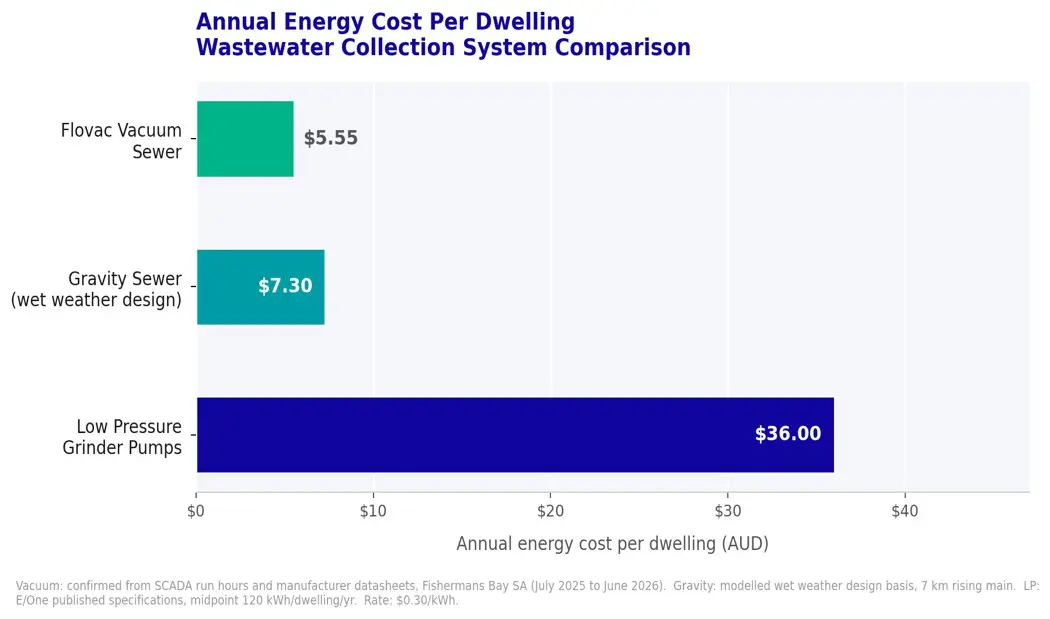
The LP energy is not zero. It is distributed across 400 electricity accounts and is invisible in the scheme operator’s energy bill. That invisibility is the reason LP systems consistently look cheaper to operate than they are.
What about gravity sewers?
Gravity sewerage is often the reference case in options studies, and on a dry-weather energy basis, a gravity system with pump stations at Fishermans Bay would come close to vacuum — potentially within 10 or 15 percent.
The problem is that dry-weather energy is not the design basis for a pump station on a high water table coastal site. Gravity sewers in sandy coastal soils experience significant groundwater infiltration through pipe joints and structural defects. This is a structural characteristic of the technology in these ground conditions, not a maintenance failure. Pump stations must be sized for peak wet-weather flows that may be 1.5 to 3 times the measured dry-weather sewage flow.
At Fishermans Bay, the modelled gravity alternative with three pump stations in cascade has a wet-weather design energy consumption 20 to 40 percent above the confirmed vacuum figure. The dominant pump station faces the same 7 km rising main to Port Broughton that the vacuum sewage pump uses, sized for a flow that incorporates infiltration from the full gravity network upstream.
Vacuum sewerage is structurally immune to this problem. The sealed reticulation carries only what enters through the Flovac valve. The infiltration energy penalty is simply not present.
The scale argument
The Fishermans Bay data confirms a per-dwelling baseline. At 400 dwellings the dollar difference between vacuum and LP is approximately $12,000 per year. Scale the system and the argument changes character.
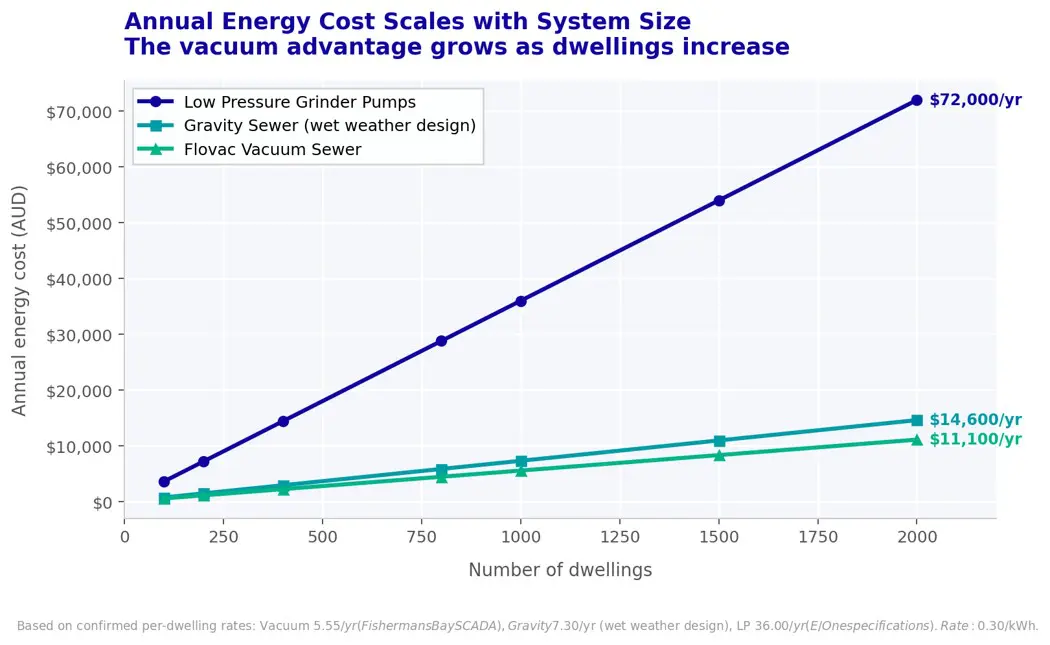
Annual energy cost grows with system size. The vacuum advantage over LP exceeds $60,000/yr at 2,000 dwellings.
At 2,000 dwellings, the annual energy cost difference between vacuum and LP exceeds $60,000. Over a 30-year asset life that difference represents approximately $1.8 million from energy costs alone, before accounting for the maintenance cost difference between 4 centrally-maintained vacuum pumps and 2,000 individually-maintained grinder pump units.
What this means for options studies
Three things follow directly from this analysis.
First, energy comparison for LP systems must aggregate all property-level pump energy. An options study that compares the vacuum pump station electricity bill against the LP pump station electricity bill is not comparing the same thing.
Second, gravity energy calculations for coastal and high water table sites must use wet-weather design flows, not dry-weather averages. A pump station sized for dry-weather flow on a high water table coastal site is under-designed.
Third, the breakeven connection count for vacuum versus LP is lower than most engineers expect. The independent Wallbridge and Gilbert study prepared for LGA South Australia in 2006 identified 75 to 100 connections as the threshold above which vacuum becomes cost-competitive. Fishermans Bay at 101 connections is above this threshold — and most LP options studies are conducted for sites considerably larger.
A note on the data
The vacuum energy figures in this article are drawn from confirmed operational data: eleven months of SCADA run hour data from the Flovac Monitoring System at Fishermans Bay, applied to motor ratings verified against manufacturer datasheets (Busch MINK MV 0502B at 7.5 kW; Grundfos SEV.80.80.110 at 11 kW). The gravity figures are modelled. The LP figures are from published manufacturer specifications. All figures are at $0.30/kWh AUD.
The 2011 Arup options report for Greenhills Beach (Kurnell) showed vacuum with the lowest capital cost and a 30-year NPV of $5.66M against $8.15M for pressure — a difference of $2.49M over the asset life. The Kurnell vacuum system, built in 1989 and covering 983 allotments, records measured energy consumption of approximately 61 kWh per allotment per year. The Fishermans Bay confirmed figure of 18.5 kWh per dwelling per year reflects a newer system with more efficient pumps, but the order of magnitude is consistent across both sites.
The full technical white paper — including methodology, data sources, gravity modelling assumptions, scale tables and a decision framework for options studies — is available from Flovac.
Data Notes
Vacuum energy figures confirmed from SCADA run hours and manufacturer datasheets, Fishermans Bay SA July 2025 to June 2026. Gravity figures are modelled estimates based on standard hydraulic practice. LP based on E/One published midpoint specifications. All figures at $0.30/kWh AUD. Figures should be independently verified for any formal options assessment. As this is an Australian project we have used pricing in Australian dollars and Australian power costs.