
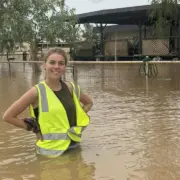
Built for a Wetter World
Most sewers were built for a climate that no longer exists. Rain is heavier, seas and groundwater are higher, and storms knock out power more often. This article looks at what that does to sewer networks — and what a network designed for today’s conditions needs to do.
When it rains, it rains harder
A warmer atmosphere holds about 7% more water vapour for every 1 °C of warming. It is basic physics — the Clausius–Clapeyron relationship — and the IPCC’s Sixth Assessment confirms the water cycle is intensifying as a result. When rain falls, it tends to fall harder.
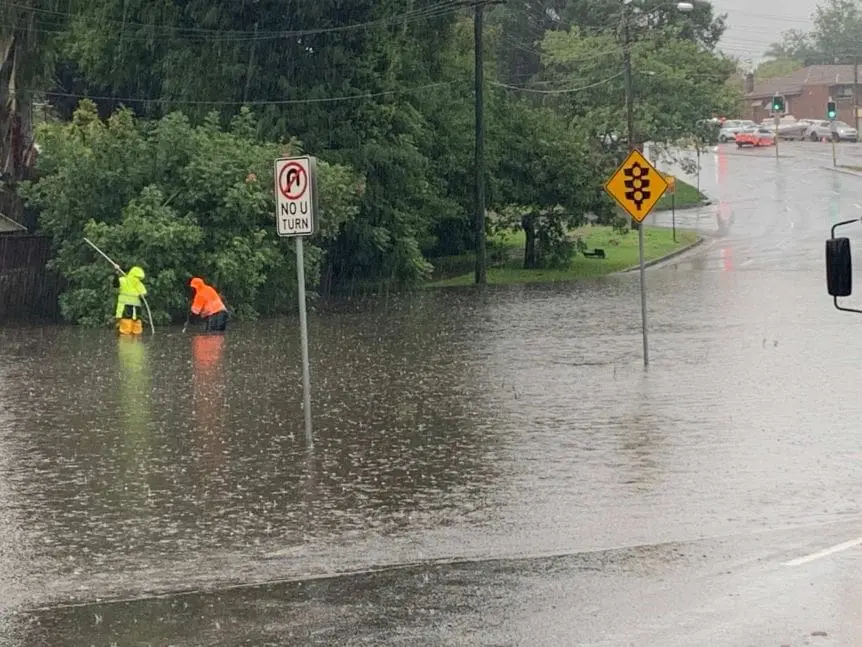
Byron Bay east coast low flooding
Recent events show what that looks like on the ground:
- Fort Lauderdale, Florida, April 2023: about 25.9 inches (658 mm) of rain in roughly 24 hours.
- Lismore, NSW, February 2022: the Wilsons River peaked at about 14.4 m, more than 2 m above the 1954 record.
- Sydney, 2022: 2,530 mm at Observatory Hill, the wettest year in records dating back to 1858.
- Thargomindah, outback Queensland, 2025: monsoon floods through the Channel Country, hundreds of kilometers from any coast.
For a sewer network, wetter means more intense short downpours, storms carrying more rain, saturated ground, and design storms exceeded more often than their annual exceedance probability suggests. Many existing networks were sized with rainfall data from decades ago. Design guidance such as Australian Rainfall and Runoff has since been updated with larger climate change uplifts — a clear signal that yesterday’s design storms understate today’s loads.
Rising seas lift the groundwater under our towns
Global mean sea level rose about 20 cm between 1901 and 2018, and the rate is accelerating. It averaged about 1.3 mm a year from 1901 to 1971 and about 3.7 mm a year from 2006 to 2018 — nearly three times faster.
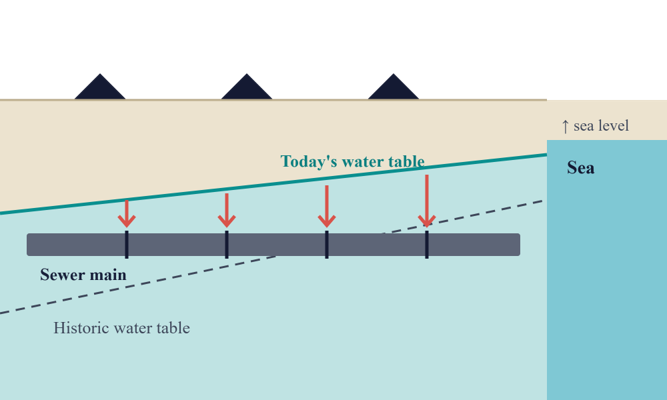
This is the part sewer engineers most often underestimate. In coastal areas the water table is hydraulically connected to the sea. Many coastal towns sit on sandy plains where groundwater is shallow and moves with the tide. As the sea rises, the water table rises beneath the whole town, not just at the beach.
A gravity sewer laid decades ago above the water table may now sit in it permanently. Every crack, joint and maintenance hole becomes an entry point, 24 hours a day. Infiltration stops being a storm event and becomes a constant load — and a king tide or storm surge adds more pressure on top.
Rising Sea Levels
Then the storm hits
On a wet day, the effects run down the network in sequence:
- Water gets in. Groundwater seeps through cracked pipes, displaced joints and private property sewers. Stormwater enters through illegal downpipe connections and over flooded maintenance hole lids.
- Pumping stations are overwhelmed. They are often at low points, so they are also the first assets to flood or lose power.
- Treatment plants are overloaded. A surge of diluted wastewater reduces treatment performance and can upset biological processes.
- Untreated sewage overflows. It ends up in rivers, bays and on beaches, or surcharges back into homes and yards.
Every litre of groundwater in the pipe takes capacity away from the sewage the system was built to carry. It also costs energy at every pumping station it passes through, and it drives capital upgrades that are really just paying to handle clean water.
Most utilities know they have an infiltration problem. Few know exactly where it is. Flow monitoring shows how much water a catchment takes in, not which pipe or property. Smoke testing finds inflow connections but misses groundwater seepage. And private property sewers — often the biggest contributor — are rarely inspected. So rehabilitation budgets get spread across whole catchments, and groundwater finds the next weakest joint.
Built for a wetter world
If you were designing a sewer network from scratch for these conditions, you would want it sealed against groundwater, able to keep working in a flood, built with few critical assets, easy to back up with standby power, and able to tell you where water is getting in. Vacuum sewerage is not new — it has decades of service history around the world — but its characteristics match that brief closely.
In a vacuum system, wastewater flows by gravity from the home to a nearby collection pit. When the sump fills, a vacuum interface valve opens and draws the wastewater into small, shallow mains, typically 1–1.5 m deep. A single vacuum pump station keeps the network under vacuum and sends flow on to treatment.
A sealed network. The mains are sealed, pressure-tested pipework with no maintenance holes, and the collection pits are sealed chambers. Because the whole network runs under vacuum, a breach shows up at the station as vacuum loss or longer pump run times. Infiltration stops being a slow, silent cost and becomes an alarm.
One station, not many. In flat terrain a gravity sewer keeps getting deeper to hold its grade, so it needs pumping stations to lift it back up. A vacuum system covering the same area can often be served by a single station. That means fewer assets to maintain, flood-proof and keep powered. The exact ratio depends on topography and density.
One power point. Storms take out the grid when the sewer is needed most — at the peak of ex-Cyclone Alfred in March 2025, more than 300,000 homes and businesses in south-east Queensland lost power. A permanent standby generator at every pumping station is rarely affordable. At a single vacuum station, built above flood level, it is standard practice.
No electrics in the street. Vacuum valves are opened by the vacuum itself, so there is no electricity at the collection pit. The Australian standard AS 4310 requires the valve, controller and fittings to keep operating while immersed to 1.5 m. Flovac’s valve and controller have been independently tested by DEKRA to ensure it meets the flood standards around the world. When the floodwater goes down, there is nothing electrical in the street to dry out or replace.
Shallow to build. Small mains in shallow trenches mean far less deep excavation and dewatering in coastal sands with a high water table.
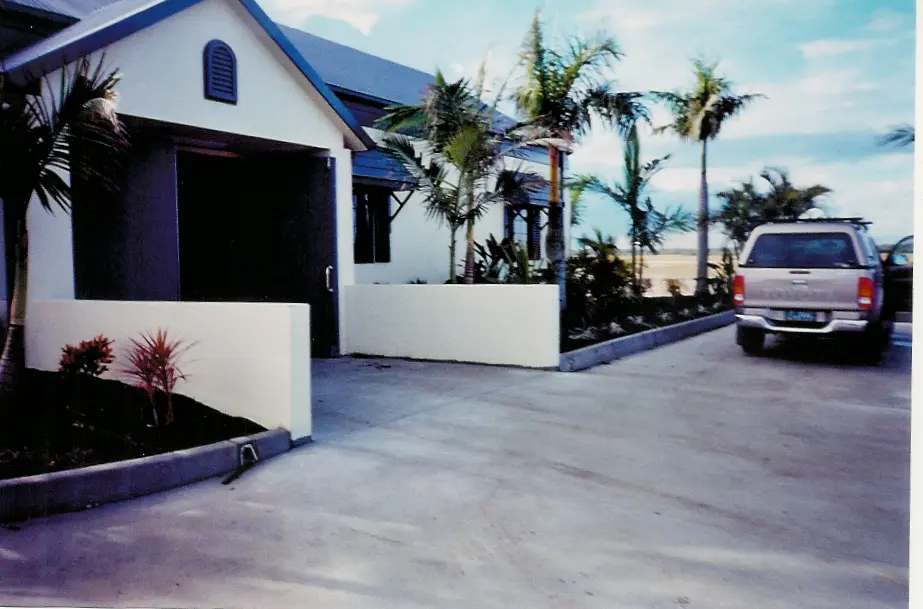
Vacuum Pump Station, this single station manages nearly 3,000 dwellings on flat land and is the only place where electricity is required.
Monitoring shows where the water gets in
With valve monitoring, every opening of every vacuum valve is logged and time-stamped. A normal household has a recognisable rhythm: busy mornings and evenings, quiet nights. A valve cycling several times an hour at 3 am in the rain is telling you water is entering at or near that property.
Key Largo, in the Florida Keys, shows how this works in practice. The Key Largo Wastewater Treatment District (KLWTD) operates a vacuum system serving low-lying canal homes with high groundwater, big tides and frequent storms. Flovac Americas refurbished the system’s valves and installed its monitoring.
Comparing valve activations at three monitored pits against each pit’s own dry-day baseline, each one responded to something different:
| Pit | High tide | Rain | Rain + high tide | What it tells the crew |
| Pit A | 1.1× | 2.0× | 2.3× | Responds to rain, barely to tide: rain-driven ingress |
| Pit B | 10.2× | 2.3× | 1.5× | Ten times busier at high tide: tide-driven groundwater |
| Pit C | 5.8× | 1.1× | 10.3× | Worst when rain meets high tide |
Activations relative to each pit’s dry-day baseline (1.0×). Data: KLWTD, Apex Companies and Flovac Americas, presented at WEFTEC 2026.
At one pit, D4, valve activations tracked the tide so closely in October 2022 (a correlation of 0.73) that crews went straight to the property and found a broken service lateral within 48 hours. No catchment-wide survey was needed — just one address.
The data tells the operator where to look; the crew confirms the cause. Occasionally that turns out to be a valve or controller needing attention rather than ingress. Either way, the search narrows from a catchment to a pit.
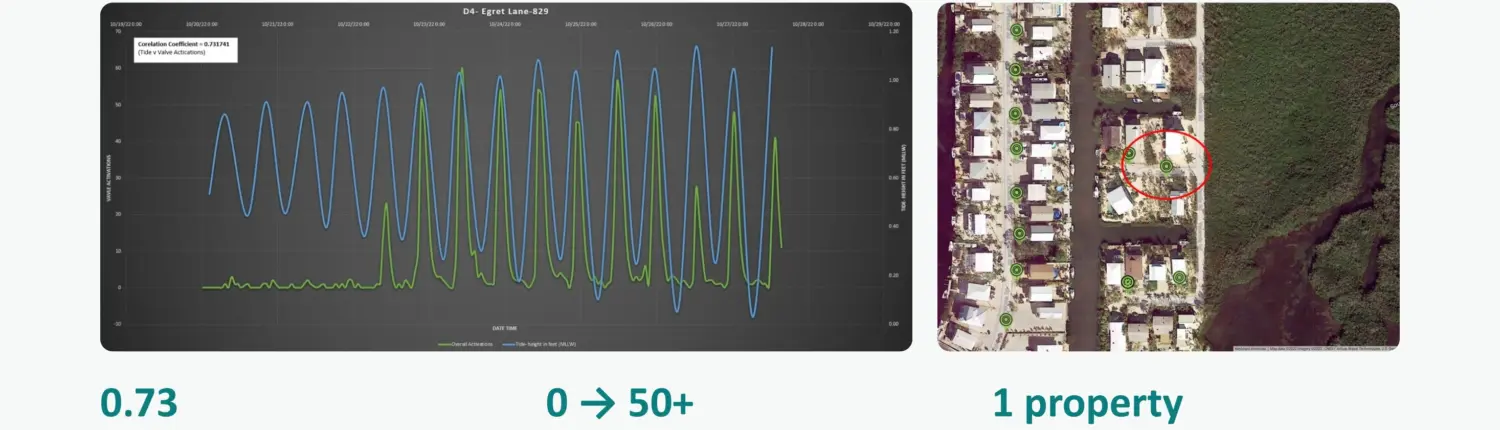
Locating tidal infiltration via monitoring
Where vacuum fits — and where it doesn’t
Vacuum is not the answer everywhere. It is strongest in:
- flat or gently undulating terrain
- high groundwater, flood-prone and coastal areas
- rock or difficult ground
- environmentally sensitive sites
- low-to-medium density, new estates and septic replacement.
It needs careful design: there are practical limits on total lift, the station must be sited above flood level with odour control, and operators need a valve maintenance regime and training. In very steep terrain, gravity or pressure sewers may be the better choice.
The places where vacuum is strongest are the same places east coast lows, cyclones, hurricanes and floods are hitting hardest — from the Florida coast to the Central Coast, and outback towns like Thargomindah.
Built for the world we have now
Many networks were designed for conditions that have since changed. A network for today should be sealed, flood-resilient, have few critical assets and resilient power, and tell its operators where water is getting in.
Flovac is a specialist manufacturer and supplier of complete vacuum sewer systems. We work with local engineers, utilities and operators from design through commissioning, monitoring and long-term support — bringing experience from projects around the world to each site’s own conditions.
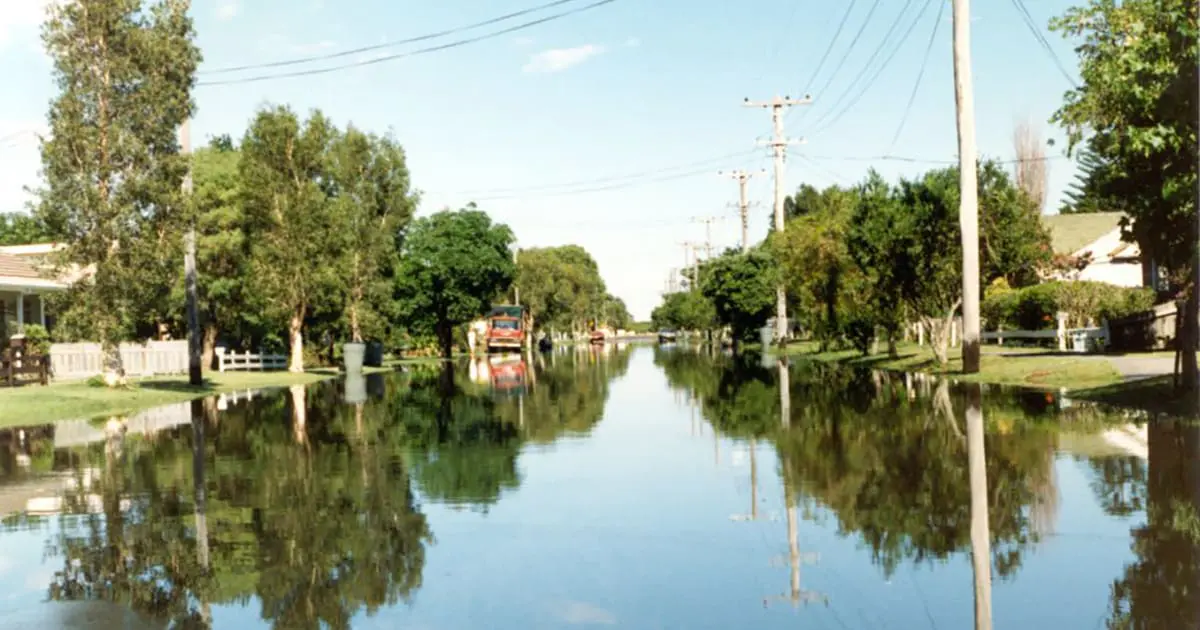
Kurnell under water but still operating
Thinking about a catchment with high groundwater or a history of wet weather overflows? Talk to us about a site-specific comparison of gravity and vacuum, worked through with your engineers.
Sources
- IPCC AR6 Working Group I (2021): water vapour per °C, sea-level rise 1901–2018 and rates of rise
- CSIRO and Bureau of Meteorology, State of the Climate: Australian rainfall extremes and regional sea-level rise
- NOAA National Weather Service: Fort Lauderdale rainfall, April 2023
- Bureau of Meteorology: Lismore 2022 flood peak; Sydney 2022 annual rainfall
- Energex outage reporting, 8–9 March 2025: ex-Cyclone Alfred
- Australian Rainfall and Runoff (Geoscience Australia): climate change guidance
- AS 4310 and EN 16932-3:2018; DEKRA test report (flovac.com)
- KLWTD, Apex Companies and Flovac Americas, WEFTEC 2026: Key Largo monitoring data
Links